
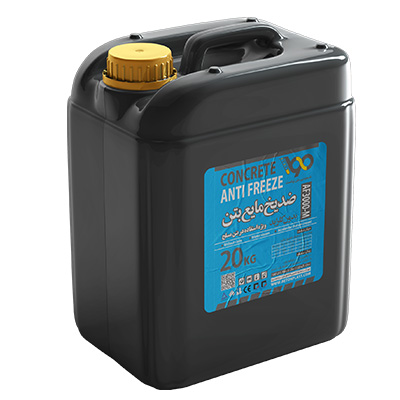
Concrete Anti-Freeze
AF3000-M
Liquid Additive for Accelerating Set Time in Cold Weather
Suitable for Reinforced Concrete
What is Concrete Anti-Freeze?
Concrete anti-freeze is a liquid additive that addresses one of the challenges faced during concrete pouring in cold weather. Cold temperatures cause the water in the concrete mix to freeze, leading to volume expansion after hardening, which results in various problems for the concrete. When the water in the mix freezes, the water that should have reacted with the cement to facilitate hydration is eliminated, leaving no water in the mix for complete hydration, preventing the concrete from setting properly. Therefore, hydration is interrupted, and the initial set does not occur. One way to prevent freezing and to speed up the initial setting is to use a liquid anti-freeze additive for concrete. This additive acts as an accelerator for the hydration process and increases the heat generation of the concrete in cold weather. The product is based on sodium nitrate, calcium, and other accelerating additives for hydration reactions, specially formulated for pouring concrete in extreme cold conditions, reducing the setting time from 12 hours to 4-5 hours. This product is intended for use in reinforced concrete and contains no harmful substances for steel. Adding the specified amount of liquid anti-freeze to the concrete mix enables a faster reaction between water and cement, leading to quicker initial setting and compressive strength gain. This product is also suitable for use with all types of Portland cement.
In general, this product prevents the phase change of water to ice, ensuring that the hydration process continues until the final set. It is used in areas where rapid setting of concrete is required. This additive enables construction in cold weather conditions.
Mechanism of Action of Concrete Anti-Freeze
What effect does liquid anti-freeze without chloride have on concrete?
For concrete or mortar to set, it is necessary for the cement and water to react so the concrete hardens and gains stability. The hydration process of cement and water slows down significantly at temperatures below 5°C. The chemical anti-freeze additive accelerates the exothermic hydration process, and by controlling and balancing the hydration process, it can prevent the concrete from freezing by adding the anti-freeze liquid.
Properties and Effects of Concrete Anti-Freeze
What properties and effects does liquid anti-freeze without chloride have on concrete?
- Accelerates the initial set time
- Enhances the heat generation of the concrete
- Increases hydration speed by about 50%
- Compatible with all types of Portland cement
- Lowers the freezing point of concrete
- Prevents corrosion of steel due to the absence of chloride ions in the formulation
- Achieves initial and final strengths in a shorter time
- Prevents concrete from freezing in cold and freezing conditions
Applications of Concrete Anti-Freeze
What are the primary applications of liquid anti-freeze without chloride?
- Suitable for preventing freezing of reinforced and non-reinforced concrete
- Ideal for concrete pouring in cold and freezing regions
- Enables concrete production and execution in temperatures ranging from -10°C to +5°C
- Accelerates the setting of concrete for faster use of the structure and formwork
- Ideal for use in conditions with rapid temperature drop
- Used for repair works in cold and freezing weather
- Suitable for manufacturing precast concrete in plants
Physical and Chemical Properties of Concrete Anti-Freeze (Without Chloride):
- State: Liquid
- Color: Yellow
- Specific Gravity: 2.1 g/cm³
- Standards: ASTM C494 – BS EN 934
- Chloride Ion: None
- pH: Approximately 8
Consumption of Concrete Anti-Freeze
How much anti-freeze liquid should be used in concrete?
The amount of anti-freeze used depends on the ambient temperature during pouring, 8 to 12 hours after pouring, and the cement content of the mix. It is important to forecast temperature changes to determine the exact quantity.
Recommended usage based on cement weight for various mix designs:
| Ambient Temperature (°C) | 300 kg/m³ Cement Mix | 350 kg/m³ Cement Mix | 400 kg/m³ Cement Mix |
| 0°C to -5°C | 2.5% | 2% | 1.5% |
| -5°C to -10°C | 3% | 2.5% | 2% |
| -10°C to -15°C | 5% | 4% | 3% |
How to Use Concrete Anti-Freeze
How is liquid anti-freeze without chloride applied?
Preparation:
- First, remove any water, snow, or ice from the formwork and rebar. If possible, warm them up to above 5°C.
- Ensure that the concrete temperature during pouring does not drop below 6°C. If necessary, maintain the temperature with appropriate coverings.
Note: It is recommended to mix for at least 1 minute per cubic meter of concrete.
Adding the Product:
- Mix the calculated amount of anti-freeze with twice its volume of mixing water. Gradually add the diluted mixture to the concrete during mixing.
- Anti-freeze can be added directly to the prepared concrete mix after thorough mixing.
Note: Anti-freeze can be added during the batching process or in the truck mixer.
Note: For every unit of anti-freeze added, the corresponding amount of water should be reduced from the concrete mix.
Safety of Concrete Anti-Freeze
What safety measures should be observed when using concrete anti-freeze?
- In case of accidental skin or eye contact, rinse immediately with plenty of clean water.
- The product is not classified as toxic, flammable, or hazardous to the environment.
- If it comes into contact with the eyes, rinse with cold water immediately.
- In case of accidental ingestion, seek medical attention immediately.
Storage of Concrete Anti-Freeze
How should concrete anti-freeze be stored?
- Shelf Life: One year in the original packaging
- Storage Conditions: Keep away from freezing temperatures, excessive heat, and prolonged direct sunlight exposure
- Ideal Storage Temperature: +10°C to +30°C
Packaging of Concrete Anti-Freeze
Packaging Type: 20 kg Gallon

Reviews
There are no reviews yet.