
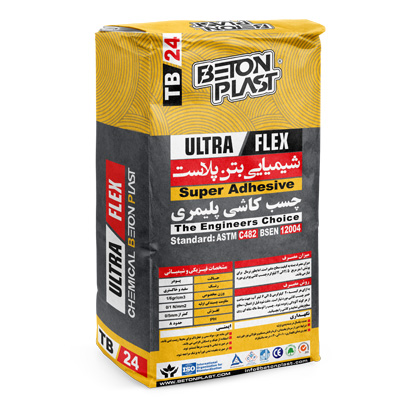
Powdered Tile Adhesive
Ready-to-use Polymer Tile Adhesive Mortar
What is Powdered Tile Adhesive?
Powdered tile adhesive, in line with technological advancements and the introduction of modern products and methods in construction, has been developed to speed up and improve tile and ceramic installation processes. One of the essential products developed for the installation and fixation of tiles and ceramics is the various types of tile adhesives. These products are produced and marketed with different formulations depending on their intended use. One of the most commonly used types of construction adhesives is cement-based powdered tile adhesive, formulated with cement, mineral fillers, and polymer resins to enhance and strengthen the adhesive power. Powdered tile adhesive based on cement reinforced with polymers becomes resistant to moisture after drying. It allows for the easy bonding of tiles and ceramics to floors, concrete walls, and even bonding tiles onto other tiles, creating a durable, waterproof surface. Due to the presence of cement and polymer resins in the formulation, powdered tile adhesive has superior adhesion compared to paste tile adhesives, making it the ideal option for installing tiles and ceramics on vertical surfaces.
Generally, this product is known as powdered adhesive, a bonding material used specifically for tile applications. It consists of dry ingredients that must be mixed with water before use. Its main components include cement, sand, and other additives. When mixed with water, a chemical reaction occurs, creating a smooth paste that is ideal for bonding tiles.
Mechanism of Action of Powdered Tile Adhesive
Powdered tile adhesive is formulated and produced with cement, copolymer resins, and micronized fillers. When mixed with water, it transforms into a bonding mortar that is used for fixing various types of tiles and ceramics on different surfaces. The combination of cement and copolymer resins in the formulation ensures optimal adhesion to the underlying surfaces. Furthermore, the presence of dispersing agents in the product’s structure provides a longer open time (gel time), allowing more time to install tiles and ceramics. This feature makes it easier to move and adjust tiles on the mortar.
Properties & Effects of Powdered Tile Adhesive
- Reduces the cost of grout behind tiles
- Reduces mortar thickness, cutting down on installation costs and increasing the interior space
- No need for additional mixing materials
- Retains adhesion in the presence of dampness and moisture
- Becomes resistant to temperature changes after drying
- Resists moisture after curing
- Easy to mix with water
- Highly resistant to sliding and minor structural vibrations
- More affordable compared to other tile adhesives
- Easy to apply with quick execution
- Provides high strength, stability, and adhesion without volume loss or cracking
Applications of Powdered Tile Adhesive
- Suitable for installing various types of tiles and ceramics on different surfaces
- Can be used to install tiles and ceramics on surfaces that are directly exposed to water and moisture
- Allows tiling over existing tiles
- Ideal for installing porcelain and granite tiles, which have low water absorption properties
- Highly suitable for high-traffic areas
- Suitable for tiling in bathrooms, restrooms, kitchens, etc.
- Can be used to install tiles in both indoor and outdoor spaces
- Suitable for applying styrene foam sheets
- Perfect for mosaic installations
- Ideal for installing coverings on cement, concrete, and stone surfaces
- Great for areas that may experience movement or structural vibrations
Consumption Rate of Powdered Tile Adhesive
The consumption rate of powdered tile adhesive depends on the condition of the substrate (porosity and roughness of the surface) and the tile grooves. On average, 2.5 to 4 kg is sufficient for 1 square meter.
Application Method of Powdered Tile Adhesive
- The surface to be tiled must be clean and free from any contaminants, loose particles, grease, etc.
- In case of contamination, clean the surface using water jet or sandblasting.
- Ensure that at least 7 days have passed since the application of fresh cement.
- For each 20 kg bag of powdered tile adhesive, 5 to 6 liters of water are required to form the mortar.
- Mixing should be done with a mechanical mixer (drill + blade) until a smooth, uniform consistency is achieved.
- Always add the powder to the water.
- If the mixing order is reversed, a uniform paste will not be obtained.
- Apply the adhesive mortar using a notched trowel on the surface, then place and adjust the tiles.
- It is recommended to also apply some adhesive on the back of the tiles.
- The mixed adhesive should be used within 35 minutes, and tiles should be installed within 20 minutes after application.
Physical & Chemical Properties of Powdered Tile Adhesive
| Property | Specification |
| Form | Powder |
| Color | White – Gray |
| Specific Gravity | 1.7 gr/cm³ |
| Workability Time | Maximum 30 minutes |
| Initial Set | 24 hours |
| Final Set | 7 days |
Safety Instructions for Powdered Tile Adhesive
- This product is not toxic or harmful to the environment.
- Due to its alkaline nature, it is recommended to wear goggles and gloves when handling the product.
- In case of skin contact, wash with water and soap.
- If contact with eyes occurs, rinse immediately with clean water.
Storage Conditions for Powdered Tile Adhesive
- The product has a shelf life of six months in its original packaging.
- Store in a place protected from frost, excessive heat, and direct sunlight.
- The ideal storage temperature is between 10°C and 30°C.
Packaging of Powdered Tile Adhesive
- 20 kg bag
Reviews
There are no reviews yet.