
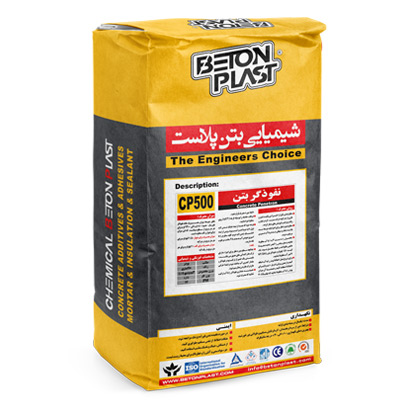
Concrete Penetron – CP500
Concrete Waterproofing with Crystalline Formation
Concrete Penetron (CP500) is a crystalline waterproofing material designed for use on concrete surfaces. This product is highly effective in sealing and protecting concrete against water infiltration and damaging chemicals. After application on the surface of the concrete, it penetrates deep into the concrete through capillary action, following the principles of osmosis. It then reacts with free lime and moisture present, forming needle-like crystals that fill cracks and capillaries, making the concrete resistant to water infiltration, ions, and harmful chemicals found in sewage and seawater. The concrete penetrator can be applied using various methods, such as spraying, slurrying, or dry application. This permanent waterproofing technique works through a process known as “blow molding,” creating lasting waterproof protection for the structure. Crystallization continues indefinitely when exposed to water, making the waterproofing effect permanent. This product poses no risk or harmful effects on drinking water, making it a safe and effective solution for waterproofing.
Unique Features and Uses of Crystalline Waterproofing:
- Application: Used for structures that are at risk of water infiltration under negative pressure conditions.
- Benefits: The material helps improve the durability and resistance of concrete against water, moisture, and environmental factors. It is available in liquid or powder form and offers an economical and effective solution for enhancing the durability of concrete structures in construction projects.
Mechanism of Action of Concrete Penetron Waterproofing
The product works by creating numerous needle-like crystals that penetrate deep into the concrete and make it completely impervious to water. It permanently blocks the path for water to enter through capillary pores, cracks, and micro-fissures. Due to its crystallization properties, it is hygroscopic, meaning the crystallization process continues as long as the material is in contact with moisture, further improving its waterproofing properties.
Properties and Effects of Concrete Penetron
- Fast and easy application
- The most advanced and powerful surface waterproofing technology
- Allows concrete to “breathe”
- Cost-effective by reducing future waterproofing costs
- Forms a uniform bond with the concrete surface
- No maintenance required
- Highly resistant to extreme temperature fluctuations
- Completely impermeable to all concrete sections
- Protects concrete and rebar from corrosion and oxidation
- High resistance to hydrostatic pressure (up to 140 meters in height)
- Resistant to ions and chlorides
- Extremely high penetration ability into concrete
- Suitable for environments with a pH between 3 and 11
- Non-toxic, free of phenols, and safe for drinking water storage
Applications of Concrete Penetron
- Ideal for waterproofing elevator pits
- Suitable for waterproofing silos and storage tanks for flour and wheat
- Perfect for waterproofing tunnels, retaining walls, and parking structures
- Used for water channels, swimming pools, and reservoirs
- A great alternative to membranes and external coatings
- Ideal for waterproofing manholes and valve pits
- Perfect for aquariums and fish breeding pools
- Suitable for underground structures, foundations, and bridge decks
- Creates self-waterproofing concrete at sites of micro-cracks
- Suitable for repairing leaks in joints, cold joints, and cracks in concrete surfaces
- Excellent for the construction of drinking water tanks and water treatment plants
Physical and Chemical Properties of Concrete Penetron
- Form: Powder
- Color: Gray
- Specific Weight: 1.09 g/cm³
- Standard: ASTM C267 – ASTM C3039
- Chloride Ion: None
- pH: 13
Standard Consumption of Concrete Penetron
The standard consumption for Penetron is approximately 800 to 2200 grams per square meter, varying by surface type:
- For walls: 1.5 kg per square meter in two layers
- For floors: 1 kg per square meter in a single layer
Method of Application
- Clean concrete surfaces to remove any weak particles, dust, paint, primer, or other coatings.
- Prepare the surfaces using sandblasting to ensure they are smooth and free of contaminants.
- Wet the surfaces with fresh water before application.
- Mix the Penetron powder with water in a 3:1 ratio, stirring until a thick, homogenous mixture is achieved. Mix one 20 kg bag of Penetron with 6.5 to 7 liters of water.
- Apply the mixture using a brush in two layers, ensuring the first layer is half-dried before applying the second. Once the second layer is half-dried, keep the surface moist with water spray for 48 hours.
- If the surface has deep cracks or damage, use a paste made from Penetron powder and less water to fill the cracks before applying the main treatment.
Important Notes
- Ensure the mixture is used within 30 minutes after mixing.
- Penetron contains cement in its formulation, so handle it accordingly.
Safety Instructions
- Use gloves, goggles, and appropriate protective clothing during application.
- The material is non-flammable and not hazardous to health or the environment.
- Penetron should never be ingested or allowed to contact eyes. In case of contact, immediately seek medical attention.
Storage Instructions
- Shelf Life: One year in its original packaging
- Storage Conditions: Keep away from freezing temperatures, extreme heat, and direct prolonged sunlight.
- Optimal Storage Temperature: Between +10°C and +30°C
- Minimum Application Temperature: +5°C
Packaging
- Available in 20 kg bags
Reviews
There are no reviews yet.