
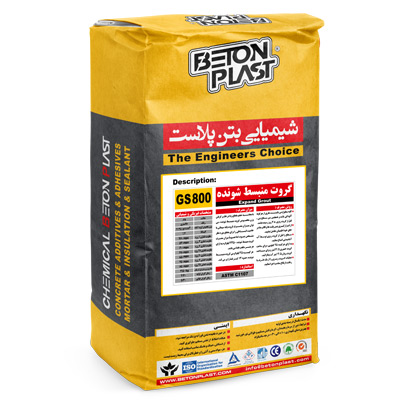
Expanding Cement Grout
GS800
High-Strength Ready-to-Use Mortar with Expansive Properties for Base Plate Installation and Stabilization
What is Expanding Cement Grout?
After positioning and leveling steel column base plates and installing anchor bolts, securing base plates on the foundation in steel structures is a crucial step. Due to the shrinkage of conventional mortar under varying weather conditions, a specially formulated grout is required to compensate for volume reduction.
Expanding cement grout is designed with a unique composition to counteract shrinkage, ensuring full contact and load transfer. Under extreme weather conditions, water loss due to evaporation can lead to voids and reduced bonding. In such cases, using an expansive grout provides additional free expansion to counteract shrinkage.
This grout is composed of cement, specially graded aggregates, polypropylene fibers, powder plasticizers, and expansion agents. It is a high-performance material with controlled workability, high initial and final strength, and rapid setting properties.
The grout expands in two stages:
- Initial Expansion: Occurs during mixing due to gas release.
- Secondary Expansion: Happens due to chemical reactions within 24-48 hours after application.
Expanding cement grout ensures full void filling and strong adhesion between materials, making it suitable for various structural and industrial applications.
Mechanism of Action
Expanding cement grout consists of:
- Graded Aggregates: Provide controlled particle distribution, eliminating weak fines.
- Powder Plasticizers: Reduce water demand while enhancing fluidity, compressive strength, and mechanical properties.
- Polypropylene Fibers: Improve abrasion resistance and mechanical performance.
- Special Expansion Agents: Prevent shrinkage and volume loss by compensating for water evaporation during hydration.
Compared to regular cementitious grouts, expansive grout offers superior free expansion and dimensional stability.
Features & Benefits
- Lower permeability compared to conventional mortars
- High durability against environmental conditions
- Excellent pumpability and flowability
- Prevents steel corrosion (chloride-free and free of metallic aggregates)
- High resistance to static loads
- Controlled expansion prevents shrinkage-induced voids
- Crack-free and seamless after hardening
- High early strength for fast load application
- Minimal water requirement for optimal workability
- Rapid structural readiness
- No segregation or bleeding
- Improved adhesion between steel and concrete
Applications
- Securing base plates in steel structures
- Anchoring industrial machinery with high vibrations
- Grouting under bridge bearings and filling voids between columns and bridges
- Filling anchor bolt holes after formwork removal
- Deep-section structural repairs
- Grouting under rail base plates in industrial plants
- Fixing power transmission towers
- Ready-to-use mortar for general construction
- Stabilizing precast concrete columns
- Injection grouting for prestressed cable ducts
- Filling voids, pits, and cavities
- Rebar and anchor bolt installation
- Strengthening columns, beams, and steel sleeves
Standard Compliance
- ASTM C 1107
Consumption
- Density: 2350 kg/m³
- Coverage: A 25 kg bag yields approximately 13 liters of grout.
Application Instructions
- Surface Preparation:
- Ensure base plates are level and firmly positioned.
- Concrete surface must be at least 7 days old.
- Gap under base plates should be minimum 10 mm.
- Surfaces in contact with grout must be free of dust, oil, and debris.
- Remove weak concrete layers using mechanical methods (grinding, water jetting, etc.).
- Formwork:
- Should be watertight to prevent grout leakage.
- Must extend 2-5 cm above the base plate.
- Use head box for large-volume grouting and inclined plates for small-scale applications to ensure continuous flow.
- Pre-Wetting:
- Saturate the concrete surface with clean water before application.
- Prevent moisture absorption from the grout into the substrate.
- Mixing:
- Use a suitable mixing container and mechanical mixer (drill + paddle).
- For plastic consistency, add 3.5 L of water per 25 kg bag.
- For flowable consistency, add 4.5 L of water per 25 kg bag.
- Gradually add powder to water while mixing continuously until a homogenous mix is achieved.
- Use the prepared grout within 30 minutes.
- Placement:
- Pour continuously from one side to prevent air entrapment.
- Assist flow using rods or chains if needed.
- For large sections, increase pouring height to improve fluidity.
- For extremely large areas, divide sections using temporary formwork.
- Maintain ambient temperature between 5-30°C during application.
- Curing:
- Once initial setting occurs, cover with moist burlap and plastic sheets to retain moisture.
- Cure for 7 days to ensure optimal strength development.
Safety Precautions
- Avoid contact with skin and eyes; rinse immediately with water if exposed.
- In case of ingestion, seek medical attention.
- Avoid inhaling grout powder.
- Use gloves, safety goggles, and a dust mask during application.
Storage
- Shelf Life: 12 months in original packaging.
- Storage Conditions:
- Keep in a cool, dry place away from direct sunlight and frost.
- Optimal storage temperature: 10°C to 30°C.
Packaging
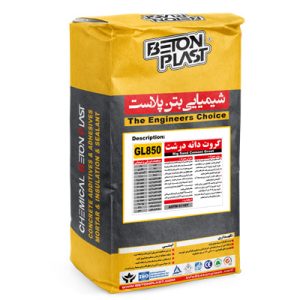
- 25 kg bags
Reviews
There are no reviews yet.