
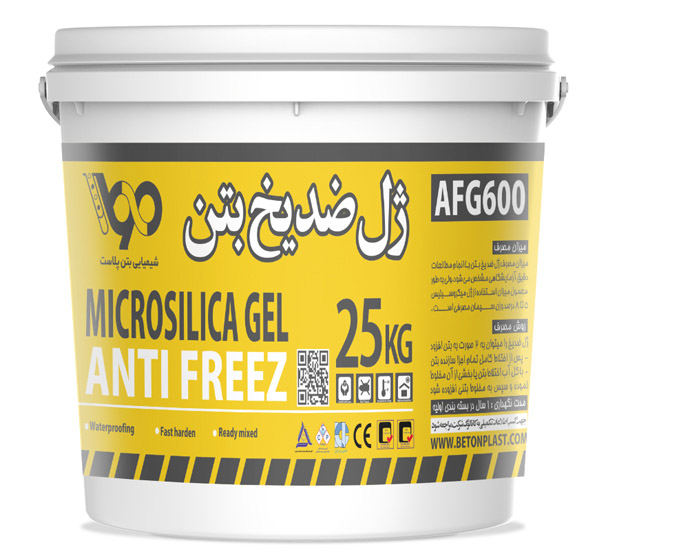
Anti-Freeze Concrete Gel
Microsilica Anti-Freeze Gel
Microsilica Gel
Anti Freeze
AFG600
Additive for Plasticizing and Waterproofing
Specialized for Concrete Pouring in Cold and Freezing Weather
What is Anti-Freeze Concrete Gel?
Anti-Freeze Concrete Gel is an additive designed using silica fume, polycarboxylate ether, water repellent materials, fillers, polypropylene fibers, and setting accelerators. It is uniquely formulated for concrete pouring in regions with cold and freezing weather conditions down to -8°C.
This gel can be used for creating high-strength, impermeable, and durable concrete. It also helps in improving the density of concrete and increasing its compressive, bending, and tensile strengths. Additionally, this additive enables a reduction in the cement content by 15 to 20 percent.
In general, this product is used during concrete pouring in cold weather conditions. It works by lowering the freezing point of the water within the concrete, increasing the internal temperature, which allows for concrete pouring in winter and helps prevent damage to concrete structures in cold regions.
How Does Anti-Freeze Concrete Gel Work?
The silica fume in the gel formulation is a powerful pozzolanic material that can replace cement, yielding results similar to that of cement. When mixed with water and calcium hydroxide, it reacts to form calcium silicate hydrate, which significantly contributes to the hardening of concrete and increases its strength. Additionally, the polycarboxylate ether in the formulation acts as a superplasticizer, forming a coating on cement particles that prevents their aggregation, and generates a repulsive force due to like charges, which helps in keeping the concrete workable.
The polypropylene fibers in the gel improve the mechanical and abrasion resistance of the concrete. The setting accelerators in the formulation speed up the hydration process and prevent freezing of the concrete before it sets.
Properties and Effects of Anti-Freeze Concrete Gel
- Prevents corrosion of reinforcement bars and steel plates
- Prevents freezing of water in the concrete before the hydration process
- Improves rheological properties of the concrete in the plastic state
- Reduces cement content by 15 to 20 percent
- Prevents cracks caused by thermal stresses in the concrete
- Prevents water bleed and segregation of the concrete
- Increases compressive, tensile, and bending strength
- Increases abrasion and electrical resistance of concrete
- Reduces water-to-cement ratio by up to 20 percent
- Improves concrete durability and stability in freeze-thaw cycles
- Significantly reduces surface cracks in concrete
- Reduces permeability to water, chloride ions, and sulfate attack
- Provides an attractive exposed surface finish
- Facilitates easy pumping and reduces wear on concrete pouring equipment
- Produces homogeneous and workable concrete
Applications of Anti-Freeze Concrete Gel
- Suitable for producing high-strength and durable concrete
- Can be used for concrete in piers, bridges, bridge decks, reservoirs, and dams
- Can be used for concrete pouring in cold regions down to -8°C
- Ideal for explosive-resistant concrete
- Suitable for industrial floors and warehouses
- Can be used in environments with freeze-thaw cycles
- Suitable for reinforced and non-reinforced concrete
- Ideal for construction in areas exposed to chemical and corrosive substances
- Suitable for concrete in water-tight structures, tunnels, water channels, treatment plants, and reservoirs
Physical and Chemical Specifications
- State: Thick slurry
- Color: Powder
- Specific Gravity: 2 gr/cm³
- Chloride Ion: None
Usage Amount of Anti-Freeze Concrete Gel
The optimal dosage of Anti-Freeze Concrete Gel is typically between 5 to 8 percent of the cement weight. To achieve high compressive strength and a robust concrete mix, 10 to 15 percent of the water in the mix should be reduced before adding the gel. The quantity added is dependent on the ambient temperature and the desired setting time.
How to Use Anti-Freeze Concrete Gel
The gel can be added to the concrete in two ways:
- Mix the product with part of the mixing water and then add it to the dry mix.
- Add the gel after all the components of the concrete mix have been combined.
Safety of Anti-Freeze Concrete Gel
- The product is not considered toxic or harmful to the environment.
- If ingested, seek medical attention immediately.
- If it comes in contact with skin or eyes, wash thoroughly with plenty of clean water.
- Always wear a mask, gloves, and safety goggles when handling any chemical products.
Storage of Anti-Freeze Concrete Gel
- Shelf life: One year in original packaging.
- Store away from cold, freezing conditions, high heat, and prolonged direct sunlight.
- Ideal storage temperature: 10°C to 30°C.
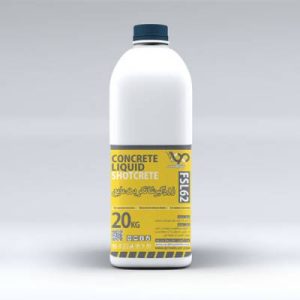
Packaging of Anti-Freeze Concrete Gel
- 25 kg bucket
Reviews
There are no reviews yet.