
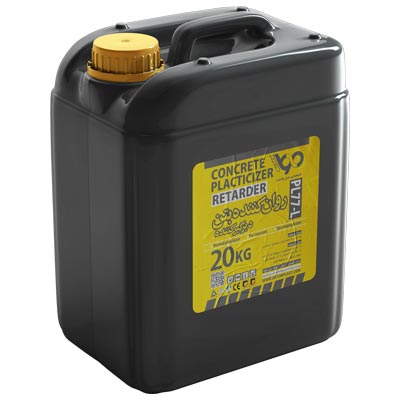
Concrete Retarder PL77-L (Concrete Plasticizer)
What is a Concrete Retarder?
A concrete retarder is a liquid additive based on lignosulfonate and set-retarding materials that can be used to increase the workability and efficiency of concrete and reduce the water-to-cement ratio in concrete mixtures. In addition to these properties, it also provides control over the early-age setting of concrete. The use of retarders is recommended for mass concrete pours and for concreting in hot weather conditions. Additionally, in situations where the distance between the concrete production and pouring site is long, adding this product at the source can help control the setting and slump of the concrete. It is important to note that while a lignosulfonate-based retarder increases resistance at later stages (e.g., after 90 days), it provides relatively low resistance at early ages. This product also reduces water content by up to about 10%.
In general, this product refers to a specialized concrete retarder used in the cement industry. It is formulated to withstand severe conditions, such as heavy loads, strong vibrations, and high temperatures commonly encountered in cement production processes.
Mechanism of Action
The mechanism of action of the concrete retarder is to improve the quality of the concrete by enhancing its workability and controlling the hydration process. When added to water and cement, the polar groups in the molecules of the retarder attach to the polar hydrocarbon chain. The polar head of the retarder molecule binds to the cement particles, preventing their agglomeration, which increases the workability of the concrete and allows for better dispersion of the particles in the mix. Additionally, retarders slow down the hydration process, extending the curing time of the concrete.
How to Identify High-Quality Concrete Retarder
A high-quality concrete retarder should have an appropriate concentration. The best indicator of its performance is how well it works when used in the recommended amounts by the manufacturer. It is essential to avoid overuse, as excessive quantities can introduce more water into the mix, which can reduce the concrete’s strength. Moreover, a well-controlled setting delay should be present in a high-quality retarder. If the setting delay is excessive, the hydration process could be delayed too much or might even stop completely.
Properties and Effects
- Increased slump and workability of the concrete.
- Extended workability time.
- Water reduction of about 10%.
- Improved compressive and flexural strength.
- Control over the initial setting time.
- Prevention of cold joints.
- Increased durability and resistance.
- Prevention of surface cracking.
- Suitable for large-scale concrete pours.
- Reduced shrinkage and creep.
- Prevents segregation and bleeding in concrete.
- Enhances bonding in poorly graded aggregates.
Applications of Concrete Retarder
- Reduces permeability.
- Suitable for producing concrete blocks and bricks.
- Used in pre-stressed and post-stressed concrete.
- Ideal for concreting in hot weather conditions.
- For concrete transport over long distances.
- Suitable for pumpable concrete mixes.
- Effective in high reinforcement density areas.
- Applicable to all structural elements of concrete projects.
- Can be used for projects requiring water reduction.
Physical and Chemical Properties
| Property | Value |
| State | Liquid |
| Color | Brown |
| Specific Gravity | 1.12 g/cm³ |
| pH | Around 7 |
| Standard | ASTM C494 |
| Chloride Ion | None |
Standard
The concrete retarder is produced according to the ASTM C494 standard.
Consumption Rate
The precise consumption rate of the retarder depends on the conditions, including weather and materials used, and is typically between 1.5% and 2% by weight of the cement in the concrete. Overuse can lead to excessive delays in setting and weaken the hydration process.
How to Use
The recommended amount of retarder should be diluted with twice the volume of water used in the concrete mix. It can then be slowly added to the mixing concrete. Ensure that the mixing process lasts for at least 1 minute per cubic meter of concrete. The retarder can be added either to the batching plant or truck mixer, but should not be directly added to dry cement.
Safety Precautions
- The concrete retarder is non-toxic and non-flammable.
- Avoid contact with eyes; if contact occurs, rinse immediately with plenty of water.
- If skin irritation occurs, consult a doctor.
- Wear safety glasses, gloves, and a mask during use.
Storage
- Store in its original packaging.
- Keep away from freezing, excessive heat, and direct sunlight.
- Ideal storage temperature: Between 10°C and 30°C.
- Shelf life: 1 year.
Packaging
- 20-liter drums
- 220-liter barrels
- 1000-liter containers
Reviews
There are no reviews yet.