
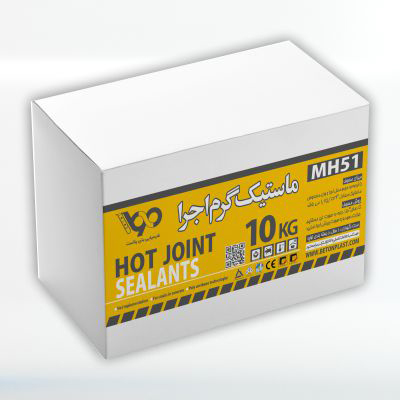
Hot-Applied Mastic Sealant
MH51
Sealant and Coating for Concrete Sections
Ready to use after heating
What is Hot-Applied Mastic Sealant?
Hot-applied mastic sealant is essential for forming expansion joints in large floors. Pouring concrete as a single layer for large floors is impractical and leads to structural weaknesses and cracks. Therefore, large floors must be divided into smaller sections, followed by formwork and concrete pouring. This method allows the large concrete floor to be constructed in smaller segments, offering significant structural benefits. The joint between these segments must be filled with a material that retains flexibility and elasticity once cured. For this reason, hot-applied bituminous mastic was formulated and produced. This hot-applied bituminous mastic is an elastic sealant based on modified bitumen rubber, used to fill expansion and contraction joints in horizontal applications. It has no negative impact on potable water. Compared to similar sealants like polyurethane mastic, hot-applied mastic is more cost-effective and easier to apply. It is ideal for sealing floors in aquatic structures, as it does not cause contamination in drinking water. Additionally, it offers excellent adhesion to various surfaces, including concrete, metal, and wood.
This product is a waterproofing material used to seal joints, cracks, and gaps in structures. Due to its unique properties, it plays a crucial role in construction and is suitable for application on concrete, wood, metal, and asphalt surfaces.
Mechanism of Hot-Applied Mastic Sealant
What is the mechanism of hot-applied mastic sealant?
Hot-applied bituminous mastic is a one-component product that becomes fluid after being heated and is ready for application. Once it cures and dries, it forms a rubber-like material with high elasticity, capable of withstanding stresses and forces. Due to its resin content, it exhibits strong adhesion to surfaces.
Properties and Effects of Hot-Applied Mastic Sealant
What are the properties and effects of hot-applied mastic sealant?
- Excellent resistance to seawater and sewage.
- Outstanding durability in various weather conditions.
- High resistance to the growth of aquatic microorganisms.
- No cracking after application.
- No loss of adhesive strength after application.
- Maintains flexibility at low temperatures.
- No sagging or dripping in hot environments.
- Excellent adhesion to concrete, metal, and wood surfaces.
Applications of Hot-Applied Mastic Sealant
What are the applications of hot-applied mastic sealant?
- Suitable for sealing expansion joints in drinking water tank floors.
- Sealing and waterproofing cracks, joints, and gaps.
- Ideal for sealing swimming pool joints used for potable water storage.
- Suitable for sealing parking garage floors.
- Compatible with use in water distribution channels.
- Can be applied on parking floors, airport runways, and streets.
- Suitable for use on roofs and balconies.
- Ideal for sealing dams.
- Suitable for sealing roads and concrete pavements.
- Ideal for sealing joints between buildings on rooftops.
- Suitable for use in water and wastewater treatment plants.
- Suitable for application in parking lots, highways, and streets.
Physical and Chemical Properties of Hot-Applied Mastic Sealant
What are the physical and chemical properties of hot-applied mastic sealant?
| Title | Feature |
| State | Elastic solid |
| Color | Black |
| Density | 1.2 gr/cm³ |
| Melting Point | 160°C |
| Maximum Heating Temperature | 180°C |
Hot-Applied Mastic Sealant Standards
What international standards does hot-applied mastic sealant comply with?
- ASTM D6690
- ASTM D1190
Consumption Rate of Hot-Applied Mastic Sealant
What is the consumption rate for hot-applied mastic sealant?
The consumption rate can be calculated based on the size of the application area and the material’s density (1.2 gr/cm³).
Application Method of Hot-Applied Mastic Sealant
How is hot-applied mastic sealant applied?
The surfaces and joints to be sealed must be free of moisture, dust, grease, and contaminants. If contaminants are present, they should be removed using a water jet, sandblasting, or air pressure.
Pour the mastic into a double-wall pot, adding thermal oil between the walls. Heat the mastic to 160°C until it becomes fluid. Once the mastic reaches a fluid state, pour it into the joint or on the desired surface. The temperature of the mastic should be maintained between 130°C and 140°C during application.
Hot-applied mastic sealant can be applied either by pouring or injecting.
Safety of Hot-Applied Mastic Sealant
What safety precautions should be observed when using hot-applied mastic sealant?
- This material should never be ingested or come into contact with eyes.
- If accidentally ingested, seek medical attention immediately.
- This material is not flammable.
- Always use goggles, gloves, and work clothes during application.
Storage of Hot-Applied Mastic Sealant
How should hot-applied mastic sealant be stored?
- Duration: One year in its original packaging.
- Conditions: Store away from cold, freezing temperatures, heat, and prolonged exposure to direct sunlight.
- Ideal storage temperature: Between 10°C and 30°C.



Reviews
There are no reviews yet.