
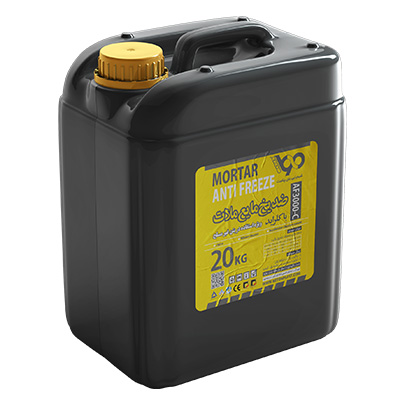
Liquid Mortar Anti Freeze with Chloride
Mortar Anti Freeze AF3000-C
Liquid Additive for Accelerating Set Time in Cold Weather
Suitable for Non-Reinforced Concrete
Liquid Mortar Anti Freeze is specifically designed to address the freezing of concrete, a common challenge when pouring concrete in cold weather conditions. Typically, concrete poured in low temperatures has lower durability compared to concrete poured in normal weather conditions. Concrete or mortar that freezes even once during the initial setting phase will be significantly weaker than concrete that has been protected against freezing. It is essential to protect concrete or mortar against the risk of freezing when working in cold environments.
This product is specifically formulated for use in non-reinforced concrete. It is a liquid additive based on chloride, sodium and calcium nitrates, and accelerating agents. When added to the concrete or mortar mix, it accelerates the setting time and enhances the hydration process. Liquid Mortar Anti Freeze reduces the setting time of concrete from 12 hours to 4 to 5 hours.
Freezing of concrete before the paste reaches initial set and gains expected early strengths causes volumetric expansion of the cement paste due to the freezing of water in the mix. This frozen water was supposed to participate in the hydration reaction but is frozen due to the cold, delaying the setting. Once the temperature rises and the frozen water thaws, the hydration process begins, requiring re-vibration and often leading to weaker concrete. This product is compatible with all types of Portland cement.
Therefore, if concrete freezes before achieving the necessary early strength, it will sustain significant damage. However, if freezing occurs after setting and the concrete has gained some durability, it will be more resistant to further freezing. It should be noted that due to the presence of chloride in its formula, this anti-freeze additive is not suitable for reinforced concrete, as it may cause corrosion of reinforcement bars and ultimately lead to concrete failure. Liquid Mortar Anti Freeze is suitable for use in mortar and non-reinforced concrete.
In general, this product is an additive used in concrete and mortar, effective even in sub-zero temperatures. It is suitable for use with steel reinforcements and helps maintain performance in cold weather. Note that car antifreeze should not be used in mortar, as the ethylene glycol it contains can damage Portland cement compounds and hydrated lime.
Mechanism of Action
What effect does Liquid Anti Freeze with Chloride have on mortar?
To harden concrete or mortar, cement and water must react, allowing the concrete to achieve durability. The cement and water hydration process slows down significantly at temperatures below 5°C. The chemical additive Liquid Mortar Anti Freeze accelerates the exothermic hydration process, and by controlling and balancing the setting process, freezing can be prevented by adding the anti-freeze liquid.
Properties and Effects
What are the properties and effects of Liquid Mortar Anti Freeze with Chloride?
- Increases the heat generation of the concrete
- Accelerates the hydration process
- Lowers the freezing point of concrete
- Compatible with all types of Portland cement
- Increases both initial and final strength
- Accelerates the initial setting time
Applications
What are the uses of Liquid Mortar Anti Freeze with Chloride?
- Preventing freezing of non-reinforced concrete
- Gravel work in cold and freezing regions
- Accelerating concrete setting for rapid use of concrete structures and forms
- Suitable for use when rapid temperature drops are expected
- Suitable for repair works in cold and freezing weather
Physical and Chemical Properties
Physical and chemical properties of Liquid Mortar Anti Freeze with Chloride:
- Form: Liquid
- Color: Blue
- Specific Gravity: 1.2 gr/cm³
- Standard: ASTM C494 – BS EN 934
- Chloride Ion: Present
- pH: Approximately 7
Usage Amount
How much Liquid Mortar Anti Freeze with Chloride should be used?
The amount of anti-freeze to be used depends on the ambient temperature during the pouring of concrete, as well as 8 to 12 hours after pouring, and the mix ratio of the concrete. Therefore, it is essential to account for expected temperature changes to determine the precise amount of product.
Percentage of Weight to Use Based on Cement Weight for Different Concrete Mix Ratios
| Temperature (°C) | Mix Ratio 300 | Mix Ratio 350 | Mix Ratio 400 |
| 0 to -5 | 2.5% | 2% | 1.5% |
| -5 to -10 | 3% | 2.5% | 2% |
| -10 to -15 | 5% | 4% | 3% |
Application Method
How should Liquid Mortar Anti Freeze with Chloride be applied?
The calculated amount of Liquid Mortar Anti Freeze should be diluted with 2 times the volume of mixing water for the concrete. The liquefied additive should be gradually added to the concrete mix during mixing.
The anti-freeze can be added to the prepared concrete mix, and after complete incorporation, the concrete pouring process can proceed.
Note: It is recommended to mix the concrete for at least 1 minute per cubic meter of concrete.
The additive can be added during the production of concrete in a batching plant or truck mixer.
Warning: The anti-freeze should not be poured directly onto dry cement.
Safety
What are the safety precautions for Liquid Mortar Anti Freeze with Chloride?
- The product is not classified as toxic, flammable, or hazardous to the environment.
- If it contacts the eyes, rinse immediately with cold water.
- In case of skin or eye contact, rinse thoroughly with plenty of clean water.
- If ingested, seek medical attention immediately.
Storage
How should Liquid Mortar Anti Freeze with Chloride be stored?
- Shelf Life: 1 year in its original packaging
- Conditions: Keep away from freezing temperatures, heat, and direct prolonged sunlight exposure
- Ideal Storage Temperature: 10°C to 30°C
Packaging
- 20 kg Drum
Reviews
There are no reviews yet.