
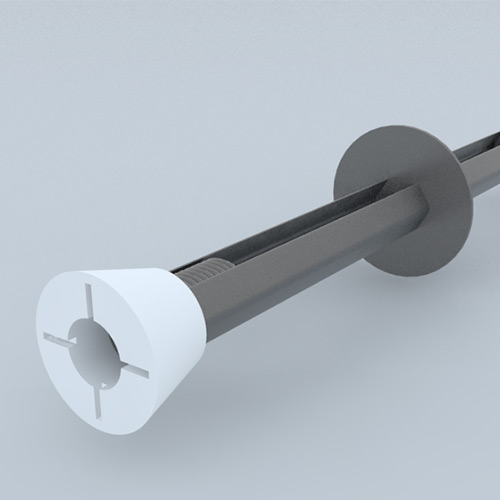
Sealing Mid-Bolt Conic (Plastic Cone for Spring Mid-Bolt)
The Sealing Mid-Bolt Conic is a plastic cone used to secure and stabilize mid-bolts in concrete formwork, particularly in the construction of concrete walls. It is designed to provide a gap between the spring mid-bolt and the formwork, preventing the metal parts from coming into contact with the concrete surface. This helps to prevent corrosion transfer from the metal to the reinforcement mesh within the concrete.
Function and Application
The Sealing Mid-Bolt Conic is used in concrete formwork, particularly in projects requiring precise stabilization of formwork during concrete pouring. It is typically made from polyethylene plastic and serves to ensure that the mid-bolt does not directly contact the formwork surface, reducing the risk of corrosion spreading to the reinforcement mesh. This plastic cone plays a crucial role in maintaining the integrity of the concrete structure, especially in water-tight concrete applications like swimming pools and reservoirs, where proper sealing around the bolts is essential.
In concrete construction, it is critical to control the pressure exerted by the concrete on the formwork. If formwork is not properly secured with bolts, washers, and nuts, the hydrostatic pressure from the concrete can cause the formwork to separate, damaging the structure. To prevent this, bolts are used to stabilize the formwork, and the mid-bolt sealing cone ensures proper sealing at the point where the bolt passes through the formwork.
Structure of the Sealing Mid-Bolt Conic
The mid-bolt sealing cone consists of a spring-loaded system with a sealing sheet in the middle. The external bolt connects to the spring, which holds the components in place. The other side of the bolt exits the formwork and is secured with washers, nuts, and supports. To prevent the metal parts of the spring mid-bolt from coming into direct contact with the concrete, a plastic conic piece is used between the spring and the formwork. This plastic cone creates a 3 cm gap between the spring mid-bolt and the formwork, preventing corrosion from spreading into the reinforcement mesh.
How to Use the Plastic Sealing Mid-Bolt Conic
- The rebar mesh is first placed, and the formwork is secured with spacers.
- The external bolt is inserted through the formwork, and the spring in the middle of the sealing mid-bolt holds it in place like a nut and bolt.
- The plastic conic piece is positioned between the spring mid-bolt and the surface of the formwork.
- The other side of the bolt is secured with the sealing mid-bolt, and the plastic cone is placed over the bolt.
- The formwork on the opposite side is then closed, and the nuts, washers, and supports are tightened, stabilizing the structure.
- After concrete pouring and formwork removal, the plastic cone is removed from the concrete surface, and the remaining hole is filled with an appropriate sealing mortar.
Consumption of Sealing Mid-Bolt Conic
The number of plastic sealing mid-bolt cones required is double the number of holes in the formwork through which bolts pass. For each mid-bolt used, two plastic cones are necessary.
Important Notes
- Failure to use the sealing mid-bolt cone may lead to corrosion transfer from the steel to the reinforcement mesh, compromising the integrity of the structure.
- After concrete pouring and formwork removal, the plastic cone should be removed from the concrete surface, and the hole should be filled with sealing mortar to prevent external contaminants from entering the reinforcement mesh.
- Using sealing mortar is crucial to reduce the possibility of destructive elements infiltrating the reinforcement mesh and degrading the structure.

Reviews
There are no reviews yet.